Steel
Steel A1008-1010 CR
Annealing Procedure
Full annealing of AISI 1010 steel is performed by heating to approximately 1600–1700°F (870–925°C), holding for sufficient time to achieve uniform temperature throughout the section, then slow furnace cooling. Process annealing (sub-critical) is performed at approximately 1000–1200°F (540–650°C) to relieve cold work stresses and restore ductility without full recrystallization. Bright annealing can be performed in a controlled protective atmosphere to maintain surface finish.
Applications
ASTM A1008 / AISI 1010 cold-rolled steel is widely used in automotive body panels, home appliances (washers, dryers, refrigerators), office furniture, computer cabinets, steel doors and frames, HVAC ductwork, electrical enclosures, general sheet metal fabrication, construction components (guardrails, handrails), hydraulic cylinder parts, and stamped or formed industrial parts. It is suitable for exposed or unexposed applications where bending, moderate drawing, forming, and welding are involved.
Cold Workability
AISI 1010 cold-rolled steel has excellent cold workability. Cold rolling and cold drawing increase strength and hardness through strain hardening while reducing ductility. Subsequent annealing can be used to restore ductility and relieve internal stresses introduced by cold working. The grade is produced in a range of cold-worked tempers from drawing quality (annealed) through full hard.
Corrosion Resistance
AISI 1010 cold-rolled steel exhibits only fair resistance to atmospheric corrosion and is susceptible to rust in humid or wet environments. It has poor performance in chloride-rich or marine environments, with significant risk of pitting corrosion. Protective coatings such as paint, powder coat, galvanizing, or zinc plating are strongly recommended for outdoor or corrosive service environments. Compared to stainless steels such as 304 or 316, corrosion resistance is significantly lower.
Formability
AISI 1010 cold-rolled steel exhibits excellent formability and is suitable for cold forming processes including stamping, bending, deep drawing, roll forming, and press brake operations. The low carbon content permits significant deformation without cracking. It is commercially available in drawing quality (DS) through full hard tempers under ASTM A1008. Work hardening effects should be monitored during multi-stage forming operations to avoid excessive strain. Minimum bend radii are typically 0.5–1.5 times material thickness depending on temper.
Heat Treatability
AISI 1010 is not typically hardened by heat treatment due to its very low carbon content (0.08–0.13%). Surface hardening can be achieved through carburizing or carbonitriding to increase case hardness while retaining a tough, ductile core. Annealing and normalizing are the primary heat treatments used to improve ductility, relieve internal stresses, and refine grain structure after cold working.
Hot Workability
AISI 1010 steel has good hot workability. Hot forming should be carried out in the temperature range of approximately 1750–2250°F (955–1230°C). The steel is forged, rolled, and worked at elevated temperatures without difficulty due to its low carbon and alloying content. Uniform heating and controlled cooling are recommended to achieve uniform properties.
Machinability
AISI 1010 cold-rolled steel has good machinability in the cold-drawn or cold-worked condition, rated at approximately 55% of the machinability of AISI 1212 free-machining steel (used as the 100% reference). Sharp tooling and appropriate cutting speeds should be used to minimize wear and achieve good surface finish. It is not as machinable as re-sulfurized free-machining grades but is suitable for most general machining operations.
Other Comments
The grade designation A1008-1010 CR represents cold-rolled steel per ASTM A1008 of SAE/AISI 1010 composition (UNS G10100). ASTM A1008 CS Type A is the most common commercial-quality designation within this specification for this composition range. The specification also encompasses drawing steel (DS), deep drawing steel (DDS), and structural steel (SS) designations at various strength levels. This grade is interchangeable with AISI 1008 in most commercial cold-rolled sheet and strip applications and is often marketed as '1008/1010 CR.' Dimensional tolerances are governed by ASTM A568/A568M.
Other Physical Properties
Poisson's Ratio: 0.29 (typical for carbon steel). Shear Modulus: approximately 11.6 MSI (80 GPa). Bulk Modulus: approximately 23.2 MSI (160 GPa). Maximum service temperature for sustained mechanical loading: approximately 750°F (400°C), above which oxidation and strength degradation become significant.
Principle Design Features
ASTM A1008 / AISI 1010 cold-rolled steel is a low-carbon plain carbon steel produced by cold reducing hot-rolled steel through a rolling mill at room temperature. Cold rolling increases strength and hardness through work hardening and provides superior surface finish, tighter dimensional tolerances, and improved flatness compared to hot-rolled equivalents. With a nominal carbon content of approximately 0.10%, this grade offers an excellent balance of moderate strength, outstanding ductility, and ease of fabrication. It is one of the most widely used cold-rolled carbon steel grades in distribution and manufacturing.
Weldability
AISI 1010 cold-rolled steel is highly weldable using all conventional welding techniques including MIG (GMAW), TIG (GTAW), resistance welding, and arc welding processes. No special preheat is required for standard thicknesses, though preheating may be beneficial for sections over 25 mm. Post-weld heat treatment can reduce residual stresses and improve weld zone properties. The low carbon content minimizes the risk of heat-affected zone cracking.
Known Forms
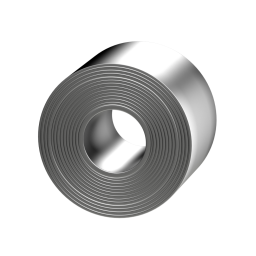
Coil
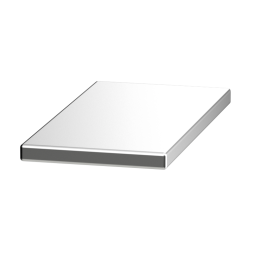
Flat Bar
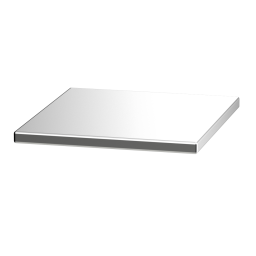
Plate
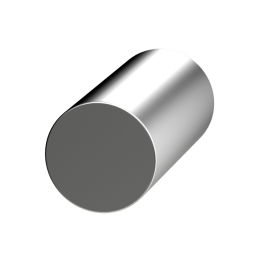
Ring
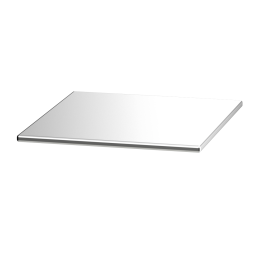
Sheet
Strip
Treadplate
Additional Data
Specifications
5044,5047,A108,A29,A510,A513,J403,G10100,A1008/A1008M,1010Chemical Elements
| Carbon | 0.08 - 0.13 |
| Iron | Balance |
| Manganese | 0.3 - 0.6 |
| Phosphorus | 0.04 max |
| Sulfur | 0.05 max |
Physical Properties
Density: 0.284lb/in³
Electrical Resistivity: 14.3µΩ·cm
Melting Point: 2600°F
Modulus of Elasticity: 29.7MSI
Specific Heat: 0.11BTU/lb·°F
Mechanical Properties
Thermal Conductivity: 27BTU/hr·ft·°F
Thermal Expansion: 6.67µin/in·°F
Thermal Conductivity
| Condition | Temperature | Conductivity |
|---|---|---|
| Cold Rolled | 70 °F | 27 BTU/hr·ft·°F |
Thermal Expansion
| Condition | Min | Max | Expansion Coefficient |
|---|---|---|---|
| Cold Rolled | 32 °F | 212 °F | 6.67 μin/in·°F |
Mechanical Test Data
| Form | Sheet |
| Condition | Cold Rolled |
| Temperature | 70°F |
| Brinell Hardness | 105 HB |
| Elongation | 20% |
| Reduction of Area | 40% |
| Rockwell Hardness | B60 |
| Tensile Strength | 52.9 KSI |
| Yield Strength | 44.2 KSI |
| Form | Coil |
| Condition | Cold Rolled |
| Temperature | 70°F |
| Brinell Hardness | 105 HB |
| Elongation | 20% |
| Reduction of Area | 40% |
| Rockwell Hardness | B60 |
| Tensile Strength | 52.9 KSI |
| Yield Strength | 44.2 KSI |
| Form | Strip |
| Condition | Cold Rolled |
| Temperature | 70°F |
| Brinell Hardness | 105 HB |
| Elongation | 20% |
| Reduction of Area | 40% |
| Rockwell Hardness | B60 |
| Tensile Strength | 52.9 KSI |
| Yield Strength | 44.2 KSI |